
Safety when working with electricity from ENERGO-PRO








Under normal circumstances, facilities belonging to the electricity distribution network do not pose a danger to the public. Nevertheless, there are cases, such as an accident of a facility, an unforeseen accident or deliberate acts of vandalism that can put society at risk. Emergency teams or citizens can report to ERP North AD about incidents such as:Under normal circumstances, facilities belonging to the electricity distribution network do not pose a danger to the public. However, there are cases, such as equipment failure, unforeseen accidents, or deliberate acts of vandalism, which can put the public at risk. Emergency teams or citizens can report incidents such as the following to EPR Sever AD:
- Contact with overhead power lines while fishing or camping.
- Contact with overhead power lines while performing agricultural activities or construction work.
- Road traffic accident causing damage to an overhead power line pole, substation/transformer station wall, or other equipment.
- Contact between an inflatable balloon, aircraft, or parachute and an overhead power line.
- Damage to an underground cable as a result of excavation work.
- Failure of equipment in a substation/transformer station, leading to an electric arc, damage to the integrity of the building or, in very rare cases, a fire.
- Accident involving an employee or subcontractor as a result of work on electricity distribution facilities.
- Flooding that affects the normal operation of the facility.
- Fire in industrial, commercial, and private premises causing damage to facilities.
Every year, there are accidents involving contact with overhead power lines, accidents at power distribution facilities, as a result of thefts at substations/transformer stations, or the formation of electric arcs when underground cables are damaged as a result of excavation work. Some of these accidents result in severe burns, and some are even fatal.
Failure to comply with safety instructions
The party responsible for damage and accidents must cover the costs of the damage caused. If a construction company repeatedly causes damage to electricity supply facilities through its irresponsible behavior, the electricity distribution company may file a lawsuit against the party responsible for the damage. In addition, the competent authorities responsible for compliance with safety instructions may impose fines on people who grossly violate labour discipline.

If you find yourself at the scene of an accident involving electrical distribution network equipment, you should be aware of the following:
- The facility may still be under strain
- Even if the equipment is not energized, you should not touch it to ensure your safety
- The equipment may be energized again without warning as a result of automatic activation or manual switching
This happens because:
- Some power supply disturbances do not cause significant disturbances that trigger automatic protections
- Disconnected wires may be under voltage
This depends on the configuration of the power supply circuit. This occurs mainly in overhead power lines, but can also occur in underground cables. Only employees of EPR Sever AD can determine whether all safety measures have been complied with so that work can be carried out on electrical equipment, overhead power lines, and cable lines.
- The power distribution system automatically supplies voltage to the equipment to restore power to customers. This is called automatic power supply circuit activation.
- The company's network management dispatch center may not be aware of the incident, so it takes operational switching measures to restore power to customers.

Different types of overhead power lines
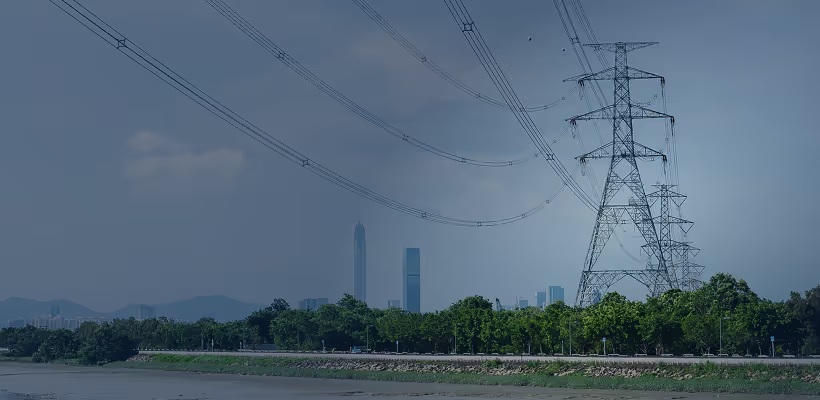
Most overhead power lines are mounted on concrete poles, usually 6 meters high. They carry a voltage of 230 volts or 20 kV, and most of them are not insulated.
Overhead power lines can also be placed on steel lattice towers.
The poles owned by NEC are significantly taller and larger. They are also steel lattice structures and carry electricity at up to 400 kV.
Conductors
Not only metal objects, such as aluminum ladders, conduct electricity. Fishing rods and telescopes made of carbon fibers and similar materials can also conduct electricity. Many other materials become conductors of electricity when wet. For high-voltage equipment, safe distances must be much greater than for lower voltages. This means that tools, vehicles, or equipment do not even have to touch an overhead power line to cause an accident resulting in electric shock, severe burns, and even death.
Precautionary measures
When vehicles and equipment come into contact with overhead power lines, the following precautions must be taken.
- Never touch overhead power lines, even if they have fallen or been knocked down by a machine.
- Never assume that they are not live. Overhead power lines may still be live or may be energized automatically or manually without warning.
- When a vehicle is electrified, you may receive an electric shock if you touch the machine and the ground at the same time.
- If anyone is in the vehicle, instruct them to remain inside until an employee of EPR Sever AD or another authorized person declares that the area is safe.
- If it is not safe for the person to remain in the vehicle, for example, if a fire has broken out in or around it, the person should be instructed to jump as far away from the vehicle as possible without touching any wires or machinery, to land steadily with both feet at the same time, and to move away from the danger zone by hopping (trying to jump with both feet at the same time).
- Do not attempt to remove equipment or a person if it is still in contact with or close to an overhead power line.
- Prevent third parties from entering the danger zone.
- Maintain a minimum distance of 5 meters.
- Treat all power lines as if they are live and therefore dangerous to your life.
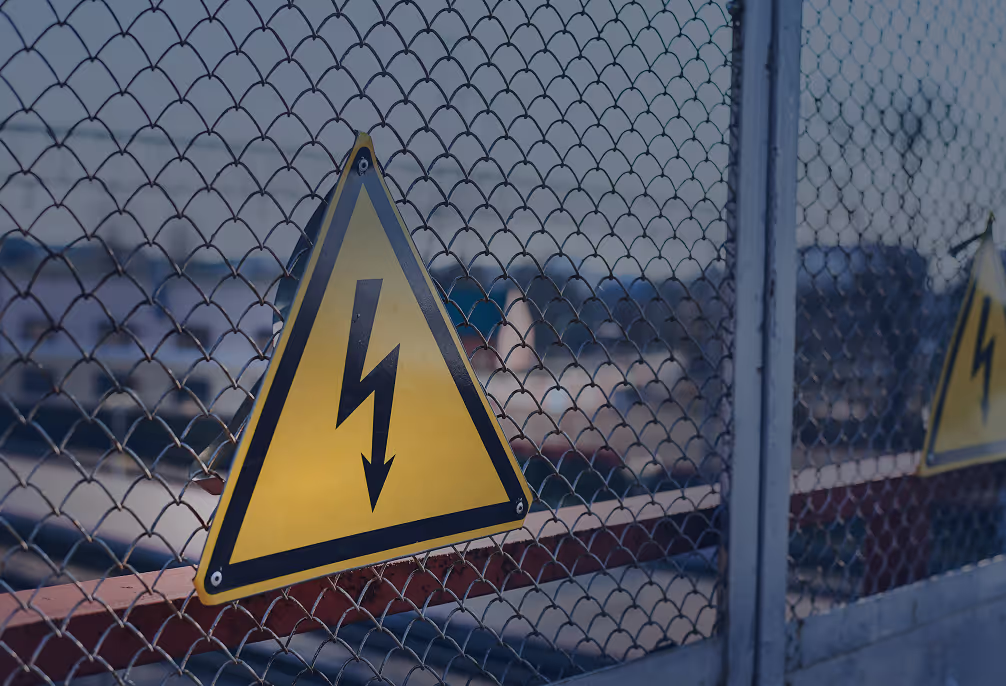
- Power lines are usually marked with a yellow sign saying "High voltage. Dangerous to life" attached to the electricity poles.
- Please note that overhead power lines are difficult to see, especially at night, against a dark background and in a wide background. They may be partially hidden from view by trees or other objects.
Instructions for construction companies
The law has defined safety zones along the routes of overhead power lines, which are 1 m for overhead lines up to 1000 V and 2 m for overhead lines up to 20 kV on all sides. No construction or excavation work, storage of materials, construction of temporary facilities, parking of machines and mechanisms, or use of large-scale machines is permitted in the safety zone without the consent of EPR Sever AD. When using construction machinery, the above-mentioned minimum distances must be observed. The distances indicated refer to the minimum distances from the conductors themselves. Depending on the weather conditions, for example in windy conditions, the conductors may sway. It should also be noted that the distance between the lowest part of the wire and the ground may change significantly in adverse weather conditions. All construction activities must be agreed in advance with EPR Sever AD.
Practice shows that:
- From the location of the cab of a machine, it is difficult to judge the real distance between the stretching part of the boom and the air power line.
- Unevenness on the surface leads, during the movement of the excavator, to uncontrolled oscillations of the stretching part of the machine.
- The load of a crane often begins to wobble uncontrollably.
- Persons moving scaffolding and other building structures do not notice that they are approaching dangerously close to overhead power lines.
- When unloading, the truck driver concentrates on the unloading process and avoids monitoring the distance to the overhead power line.
Precautionary measures
If the construction work requires proximity to the minimum distances from overhead power lines, it is advisable to take the following actions to ensure that the danger zone does not slip into the danger zone:
- The appointment of a responsible person who monitors all the activities of the machines and is responsible for the safety of the construction site.
- Placing partitions to ensure compliance with minimum distances.
- Placing protective equipment in front of and behind the power line so that it cannot be touched by construction equipment.
- Limiting the radius of rotation of the crane.
- Movements of machines shall take place only when their moving parts (jibs, platforms, baskets, etc.) are in the transport position.

If you find yourself at the scene of an accident involving electrical distribution network equipment, it is vital for your personal safety and that of others that you follow the instructions below. Detailed information is provided in the sections: "Overhead power lines," "Underground cables," "Substations and transformer stations," and "Industrial, commercial, and residential premises."
Make sure that:
- You are at a safe distance (at least five meters) from any circuit breaker/switch, equipment, overhead power line, or underground cable that is live or damaged.
- Do not touch anything, even if it seems that there is no voltage and it is safe.
- Do not allow other persons who arrived with you or after you at the scene of the accident to enter the danger zone.
- Contact the ENERGO-PRO Call Center immediately - 0700 161 61 and 0700 359 10
- Follow the instructions of the employees of ERP North AD related to safety at work.

DANGERS
The discovery of underground cables
Since underground cables are laid under a significant amount of soil and other material, you may not find that the cable is damaged. However, during excavation work, for example, when laying a new road surface or laying underground communication, there is a chance that you will come across a cable.
Cable injuries
Underground cables are power lines that have a protective insulating coating. Damage to the insulating coating of the cable can lead to electric shock or cause serious burns.
PRECAUTIONS
In case of underground cable accidents, it is important to build away from potholes and trenches until an employee of ERP North AD or other authorized person declares the site safe.
Undertaking a rescue operation
If a person is in contact with a damaged wire on a cable line, you need to consider whether it is possible to carry out a rescue action. It is necessary to make sure that:
- ERP North AD has been notified of the rescue operation. The company will do everything possible to prevent re-supply of voltage to the damaged cable. The company may undertake an attempt to perform operational switching of the network in order to cut off the power supply on the cable in the area of the accident.
- There is enough space around the injured person and there is no danger for the rescuer to touch the faulty cable or the bare wire.
- For the safety of the rescuer, it is necessary to pull the victim aside from the scene of the accident with dielectric gloves or other insulating material.
Measures after a rescue operation
Always assume that the cables are energized or can be re-energized without warning. For this reason, once you have completed the rescue operation, stay at a safe distance from the cable.
It is impossible to find out whether an underground cable is under voltage or not without a special technique used by ERP North AD. For this reason, always assume that the cable is under voltage, regardless of whether it looks physically old or has a neglected appearance.
INSTRUCTIONS FOR CONSTRUCTION COMPANIES
Every construction contractor is obliged to assume that during the construction activities carried out by him, in public or private land, it is possible to come across underground cables. For this reason, he must always approach with due care and take measures to prevent damage to underground cables, which can endanger the health and life of people. He is obliged to conduct a briefing of his employees and subcontractors and check them for compliance with safety measures.
The presence of a representative of the electricity distribution company at the construction site does not remove the responsibility of the developer or his subcontractor for damage to the electricity distribution facilities. The integrity and normal operation of electricity distribution facilities in the area of construction work must be guaranteed both during operation and after the completion of construction activities.
Work near underground cables
When carrying out construction work, the developer is obliged by the current legislation to carry out survey activities at the construction site and secure it.
In case of construction work near electricity supply facilities, inform the electricity distribution company in a timely manner (at least 2 weeks in advance) about the upcoming activities, providing written information on the start and scope of the works.
Before the start of construction work, the developer must have familiarized himself with the exact location of the electrical equipment, having studied in detail for this purpose the electricity supply schemes provided to him by the electricity distribution company.
Depth of laid underground cables
Basically, underground cables are laid to a depth of not less than 80 cm. A thinner layer of cable coating is possible, especially in the power supply of houses. These values are for general orientation only, since the initial laying depth cannot be considered as an invariant quantity. The location and depth of the cables can be changed as a result of the wear of the earth's surface, landslides, embankments that occurred after their laying, that is, the change in the depth at which the cables are located may be due not only to repair work performed. For this reason, it should not be assumed that the changes are noted in the plans. Therefore, it is imperative that the exact depth of the cables be established by means of a transverse trench and grooves in the soil.
Marking
Before the start of excavation work, it is necessary to mark the route by pegs, spray or other materials and limit the depth of the excavation to ensure the integrity of the underground cables. If a warning sign, protective cover, cables or pipes are encountered in places not previously indicated by the electricity distribution company, the work must be stopped and restored only after consultation with the electricity distribution company.
The disclosure of underground cables
In the area of underground cables, it is permissible to operate excavation equipment only when all necessary measures have been taken to prevent damage to them. It is allowed to use excavation equipment only to a depth that does not pose a danger of damage to the cables (up to 40 cm). Their unraveling is carried out necessarily manually, and the use of sharp objects, such as a pick, is prohibited.
It is desirable to move the wires carefully, in a horizontal position. If it is planned to deploy infrastructure under them, it is imperative that these actions be coordinated with the electricity distribution company.
Directional signs and overhead equipment
Overhead facilities, such as armature, power distribution equipment, distribution and metering cassettes, distribution boxes, street and other shafts must necessarily remain accessible and not be cluttered. Directional signs, inscriptions and other markings shall not be removed, moved or cluttered without the express consent of the electricity distribution company.
Damage to cables
Any damage must be reported immediately. This applies not only to a possible rupture of the cable, but also to the slightest injury to its outer coating. Violation of the outer layer of the cable can lead to serious interference with the power supply. Faults that are eliminated on time take less time and cost.

DANGERS
Substations
There are a number of non-insulated power lines in the substations. Even when the power lines are higher, the insulators to them are easily accessible, and touching them can lead to electric shock. Substations have equipment and switches that are controlled remotely. This can cause serious injuries if you are, for example, in the area where an operative switching is performed.
Transformer posts
They are provided for the power supply of domestic consumers. The equipment in them is under voltage (bus system, transformer machines with an average voltage of 20 kV, as well as distribution equipment up to 1000 volts).
Precautions
In case of any accidents, do not enter a substation without an authorized person from ERP North AD to arrive on the spot. Only it will be able to carry out safety briefing of the rescue teams.
An exception to this can be made when someone who is located far enough from the electrical facilities needs to be rescued, and an authorized person has not yet arrived at the scene. The following precautions are very important:
- Follow a route around the inside of the fence. Avoid going under overhead line wires and stay as far away from facilities as possible.
- Never use or carry a long object or ladder in the area of the substation.
- Never climb a structure or part of a facility.
- Look for hanging parts or wires, as well as objects or damaged/torn wires on the ground.
- Do not attempt to move a person if it is still in contact or near overhead line wires, or is located on a facility.
- Do not allow third parties to enter the area of the accident.
- Maintain a minimum distance of 5 meters.
- In case of doubt about your safety, stay outside and wait for the arrival of employees of ERP North AD.
In case of accidents at substations or transformer stations, follow the instructions below. - Do not rely on the presence of sound. Most objects have transformers that make a buzzing sound, but there are other facilities that do not make a sound. The absence of sound does not mean that the facility is not energized. For your safety, allow all equipment in the facilities to be energized.
- Stay at a safe distance from the facilities in case of their re-energization.
- If a damaged piece of equipment is put under voltage again, it can eject burning oil, and there is a danger of flying ceramic or metal debris or the formation of an electric arc. All of these events have the potential to cause serious or fatal injury to anyone who is near the facility.
Beware of wires
Carrying any equipment with a length of more than 3 m in substations with exposed wires should be considered dangerous. Because not only metal objects, such as aluminum stairs, can be a conductor of electricity. When wet, many other materials will allow electricity to flow on them, and some lightweight materials, such as carbon fiber or wood, are natural conductors.
Electricity can jump
At higher voltages, electricity can jump short distances through the air. This means that when using tools, vehicles or equipment, safe distances to an air conductor in a substation must not be reduced, so as not to cause electric shock resulting in serious burns or resulting in death.
Toxic gases and particulates
The equipment of some substations contains sulfur hexafluoride gas (SF6). In the normal state, it is not poisonous, but it can release some toxic materials when exposed to an electric arc. While some of the gas products are gaseous and dissipate rapidly in the atmosphere, others are solid and appear as a fine white powder on the surface of the facilities. If this powder is inhaled or penetrates the eyes, it can cause serious permanent damage due to the acid content when combined with water or moisture.
Fire extinguishing of live equipment
The use of water or foam on electrical installations under voltage is strictly prohibited. If the facility is still energized, the water or foam may cause it to explode or cause the person extinguishing the fire to come under tension.
Fire extinguishing of non-energized facilities
When the equipment is not energized, fluoroprotein foam can be used to extinguish the fire. You can do this after assessing the potential damage of the foam to the environment. You need to take measures so that the foam does not flow down the drainage channels and from there reach streams, rivers, waters, ponds, lakes.

In the event of an emergency, contact the ENERGO-PRO Call Center. This will ensure that you speak directly to the team that makes all decisions on how to respond to power grid incidents.
ENERGO-PRO has round-the-clock telephones - 0 700 161 61and 0700 359 10, on which you can contact the company in case of an accident or accident.
What is important in these cases:
- Clearly identify yourself and clarify the fact that your call is related to an ongoing accident or incident.
- To provide as detailed information as possible regarding the scene of the incident and the current situation of the object. Record and transmit any designations, such as pole identification numbers or the name of the substation or transformer post.